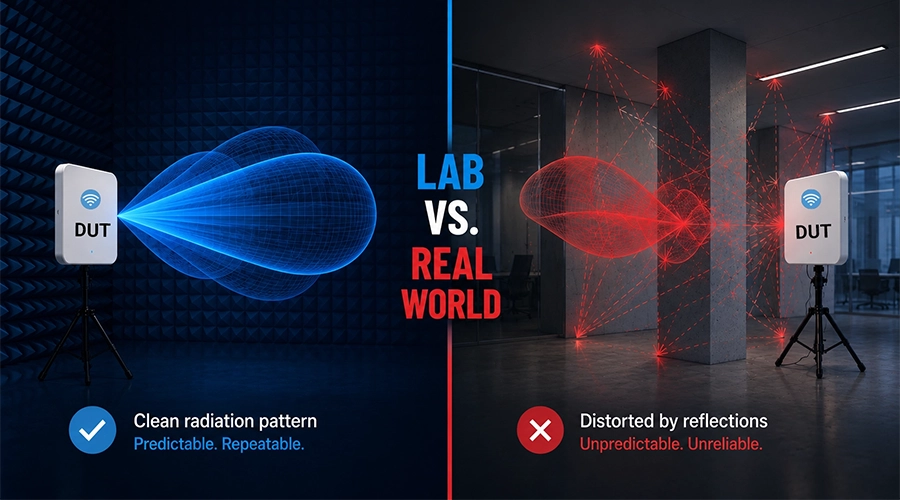


A datasheet antenna spec tells you how the module radiates on a reference board in an anechoic chamber. It does not tell you what your product will deliver in the field. CEL’s own test data shows the gap. On a 50 ft trailer, the CMP9611 ran 251.4 Mbps on 5 GHz at the front and had no link at the rear roofline. The evaluation board it sat on had about a quarter of the ground plane its antenna was designed for.
This post covers what peak gain and TRP measure, what they leave out, and what CEL has measured when modules go into real hardware.
What Peak Gain and TRP Measure
Peak gain, in dBi, is the antenna’s strongest direction relative to an isotropic radiator. Total Radiated Power (TRP), in dBm, is the power radiated over the whole sphere. TRP includes conducted power, losses in the RF path, and antenna efficiency.
Both are chamber measurements, and both vary more than a single datasheet line suggests. CEL measured the CMP4612 with +16 dBm requested output power using OFDM:
| Channel | 1 | 7 | 11 | 36 | 100 | 165 |
|---|---|---|---|---|---|---|
| TRP (dBm) | 13.9 | 14.6 | 13.2 | 16.3 | 13.4 | 11.2 |
That is a 5.1 dB spread across channels on one module in free space. CEL’s one-pager notes that TRP also moves with power amplifier tolerance and with components in the RF path. Source: CMP4612 TRP and Peak Gain (PDF).
What a Throughput Test Adds
Throughput, or packet error rate, measures the whole link. The signal passes through baseband processing, mixing, filtering and amplification before it leaves the antenna, and each stage adds loss. Amplifiers add noise and compress at high power. Filters add insertion loss. Phase noise, I/Q imbalance and DC offset reduce the SNR the demodulator gets.
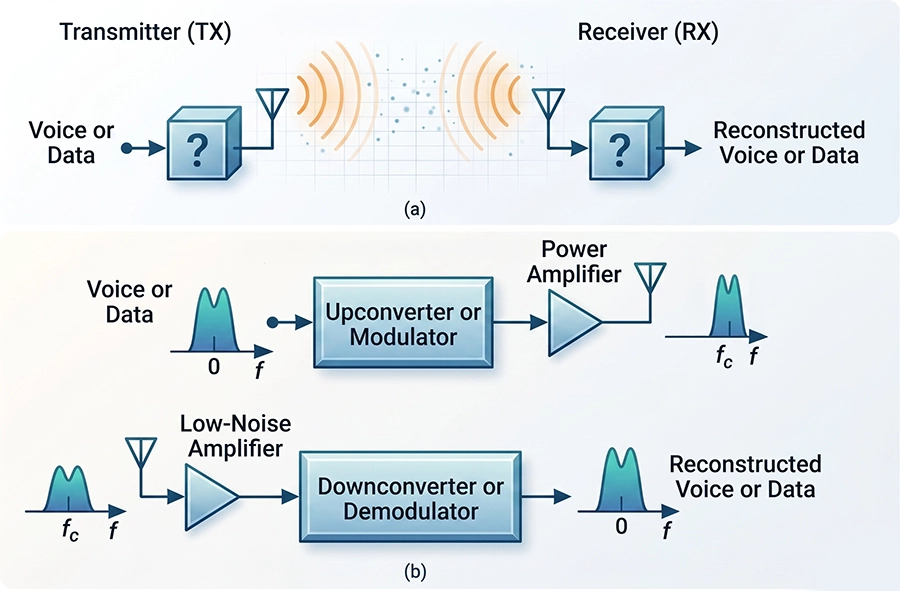
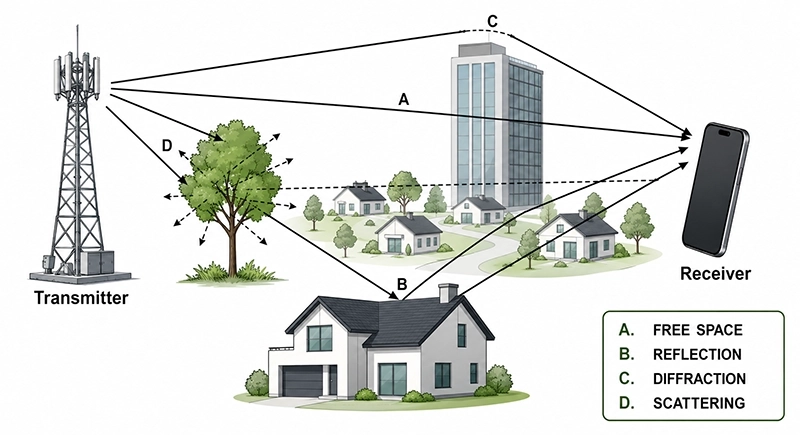
Then the signal leaves the chamber’s free space for a real building or vehicle. Walls and metal reflect it and cause multipath fading. Distance and polarization mismatch cost more margin. Nearby metal and plastic detune the antenna and distort its pattern.
Ground Plane Size
A PCB trace antenna is tuned for a ground plane of a certain size. Shrink the ground and the radiated signal drops, and the loss grows with distance. CEL’s trailer test put three Wi-Fi 6 modules on evaluation kits held in free space on a PVC and cardboard fixture, with the access point in the truck cab and 89 other access points in range. Throughput was measured with iperf over UDP.
| Position | CMP9610, 5 GHz | CMP9611, 5 GHz |
|---|---|---|
| 1, front of trailer, low | 47.2 Mbps | 251.4 Mbps |
| 2, front roofline | 27.7 Mbps | 142.1 Mbps |
| 5, mid-trailer roofline | 26.5 Mbps | 21.7 Mbps |
| 6, rear roofline | 4.8 Mbps | No link |
The CMP9611 is about 5x faster up close. By mid-trailer the CMP9610 is ahead, and at the rear roofline the CMP9611 has no link. CEL attributes the CMP9611’s drop-off to its evaluation kit, which provides about a quarter of the antenna’s reference ground plane. Sizing the ground plane to spec on your board is the fix. Source: Wi-Fi 6 Trailer Streaming Field Test (PDF).
Enclosure and Placement
CEL tested a commercial controller built on the CMP9610-2, in a plastic housing with an LCD display, in an office. The module runs about 16 dBm conducted power on both bands. The CMP9610 antenna one-pager lists about 75% efficiency at 5 GHz and over 75% at 2.4 GHz. Inside this housing, CEL puts typical efficiency near -3 to -4 dB at 5 GHz, and lower at 2.4 GHz. That means only 40 to 50% of the power gets radiated, before the signal reaches the first wall.
This test ran in legacy modes: 802.11g on channel 6 and 802.11a on channel 48, both 20 MHz, with iPerf3 on a laptop with an Intel AX201 card. Each value is the average of three runs.
| Client location | 2.4 GHz (802.11g) | 5 GHz (802.11a) |
|---|---|---|
| 1, near the controller | 38.0 Mbps | 51.5 Mbps |
| 2, through interior drywall | 18.5 Mbps | 22.2 Mbps |
Interior drywall cut throughput roughly in half on both bands. At location 3, past the building’s concrete perimeter, 2.4 GHz fell to 3.42 Mbps. CEL’s review also found layout fixes the chamber spec could never show. Moving the module so the antenna’s short-segment side has at least 11 mm of ground plane, and the long side has 3 to 5 mm of ground beside it, would improve performance. So would mounting the controller away from metal. Source: CMP9610 Office Throughput One-Pager (PDF).
Band, Height and Distance
In a separate test, a CMP9611 ran as an access point inside a closed SUV, with no enclosure, in a neighborhood with about 90 SSIDs. On 802.11ac it measured 62.4 Mbps with the laptop on the hood and 15.6 Mbps at 100 ft. On 802.11g, 2.4 GHz measured 23.0 Mbps on the hood, 15.5 Mbps at 100 ft and 2.41 Mbps at 300 ft. Every 5 GHz mode lost signal between 130 and 150 ft. CEL’s recommendation was to raise the access point above 4 ft in the cab and to configure bands per use case. Source: CMP961x Throughput and Range Field Test (PDF).
5 GHz carries more data close in. 2.4 GHz reaches farther. A datasheet gain figure for each band does not tell you where that crossover falls in your product.
Test the Product, Not the Module
CEL’s integration support follows the same order:
- Simulation before layout. CEL imports your STEP file and compares candidate module locations for efficiency and radiation pattern. See RF Simulation Testing (PDF).
- TRP of the end product. CEL measures in its anechoic chamber in three steps: radio board alone, radio board plus display, then the finished product. The connected power tool case study (PDF) shows this for a CMP9611 design with an LCD, battery and motor.
- Field throughput. iperf or packet error rate in the building or vehicle the product will ship into.
Module TRP is a good reference point. Your product’s TRP and throughput decide whether it works.
Want CEL to review your antenna placement or run TRP on your enclosure? Use the form below and a CEL engineer will follow up.