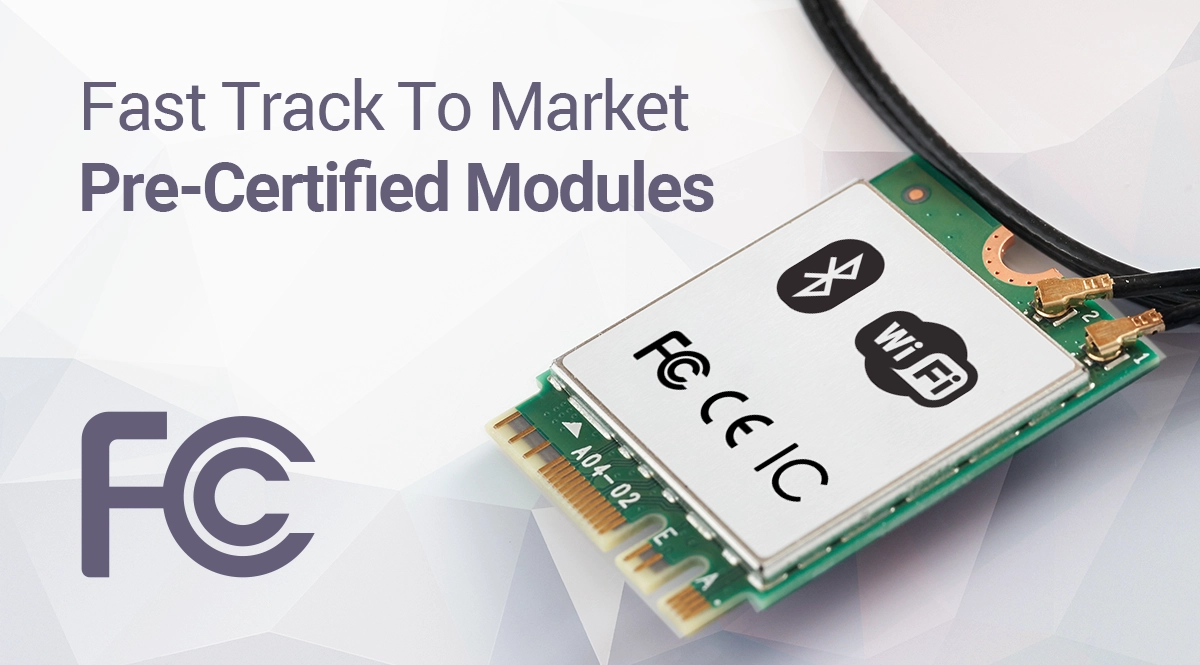


A pre-certified module moves the radio’s certification cost and schedule risk from you to the module vendor. You pay for that in unit price, board area and antenna freedom. Whether the trade pays off depends on your volume, your schedule and how many countries you ship to.
This post covers when a pre-certified Wi-Fi or Bluetooth module beats a chip-down design, and when it does not. For the steps you still take with a module, see FCC Certification Guide: 7 Steps to Product Approval.
What a Module Takes Off Your Plate
| Work item | Chip-down | Pre-certified module |
|---|---|---|
| RF layout, matching, shielding | You | Module vendor |
| Crystal, front end, power management | You | On the module |
| FCC intentional radiator tests (Part 15C, 15E) | You, for a new FCC ID | Covered by the module grant |
| ISED radio tests (RSS-247) | You | Covered by the module certification |
| EU radio tests (EN 300 328, EN 301 893) | You | Module reports support your technical file |
| Per-unit RF calibration and production test | You, with your own fixtures | Done before the module ships |
| Host digital emissions (Part 15B, ICES-003, EU EMC) | You | Still you |
| Labels, SDoC, EU Declaration of Conformity | You | Still you |
The bottom two rows never go away. A module removes the radio work, not the product work.
One EU note: the EU has no modular grant. You are the manufacturer of the finished radio equipment and you sign its Declaration of Conformity. The module’s test reports carry into your technical file as long as your integration keeps them valid.
Cost: Run Your Own Numbers
Chip-down has the lower bill of materials. It also carries one-time costs a module avoids: RF design time, extra board spins, radio certification in every region, and a production RF test station. A module flips that: higher unit price, almost no radio NRE.
The break-even volume is:
(chip-down NRE minus module NRE) / (module unit price minus chip-down radio cost per unit)
Put your own quotes into it. Count chip-down radio cost per unit as parts plus assembly plus production test time. Count certification for every region you plan to ship, not just the US. Each new market adds to the chip-down NRE but adds nothing for a module that already lists that region.
Schedule: Where the Risk Sits
On a chip-down design, radio certification sits on the critical path. A failed spurious emissions test means a board spin and another lab slot. With a module, the radio has already passed. Your remaining risk is host emissions under Part 15B and EMC, which a pre-scan at the first prototype usually exposes early enough to fix at layout.
The Trade-Offs
- Board area. The CMP9605 is 16.7 x 20.0 mm. The CMP961x is 16.64 x 27.80 x 3.47 mm as a full module, or 12 x 12 x 1.85 mm as an LGA. A chip-down layout can be smaller if you have the RF skills.
- Antenna keep-out. An integrated PCB trace antenna needs clear space around it on your board and away from metal in the enclosure.
- Antenna choice. The grant covers the antennas that were tested. A connector version such as the CMP9702 (two u.FL ports) or an MHF4 option on the CMP9610 lets you mount the antenna where it works in the enclosure, but the antenna has to match the grant or go through a permissive change. Ask CEL which variants and antennas each grant covers before you lay out the board.
- Chipset and software. You get the chipset the vendor built on and the driver and firmware it supports.
There is a middle path. A fleet telematics customer needed something smaller than the CMP9010 standard module (462.6 mm²). CEL moved them to the CMP9010-9 stamp module (about 192 mm²) with a 12 x 4 mm antenna designed for their PCB, then obtained a Class II permissive change instead of a full certification. Case study (PDF).
When Chip-Down Makes Sense
- Volume is high enough that per-unit savings clear the NRE by a wide margin.
- Space is so tight that even a 12 x 12 mm LGA plus antenna will not fit.
- You have an RF team and chamber and already certify other radios.
- The product needs its own grant anyway, for example a body-worn design that needs a SAR evaluation the module vendor will not file. At that point much of the module’s certification advantage is gone.
Bluetooth SIG and Wi-Fi Alliance Are Separate
FCC, ISED and CE are legal requirements. Bluetooth qualification is a trademark license. A product using the Bluetooth name or logo needs its own Bluetooth SIG listing and declaration fee, even with a qualified module inside. Referencing the module’s qualified design cuts the testing, not the listing. Wi-Fi CERTIFIED is optional, and it is not required to sell the product.
CEL Pre-Certified Modules
Hosted modules run from a Linux, Android or RTOS host processor. Hostless modules such as the CMP4612 run your application on the module’s own Cortex-M33. Weighing a module against chip-down for a specific product? Use the form below and a CEL engineer will follow up.
Hostless
| Module | Radios | Certifications listed | Size |
|---|---|---|---|
| CMP4612 | Wi-Fi 6, BLE 5.4, 802.15.4 | FCC, IC, CE | 16.7 x 28.6 mm |
| CMP4020 | Wi-Fi 4, BLE 5.0 | FCC, IC, CE | 16.7 x 26.3 mm |
Hosted
| Module | Radios | Certifications listed | Size |
|---|---|---|---|
| CMP9605 | Wi-Fi 6, BLE 5.4 | FCC, IC, CE | 16.7 x 20.0 mm |
| CMP9610 | Wi-Fi 6, BLE 5.4, 802.15.4 | FCC, IC, CE | 16.64 x 27.80 mm |
| CMP961x | Wi-Fi 6, BT 5.4 | FCC, IC, CE | 16.64 x 27.80 mm |
| CMP9702 | Wi-Fi 7, BT 5.4 | CE, FCC, IC, NCC, Japan | 30.0 x 22.0 mm (M.2 2230) |
The CMP9610, CMP9611, and CMP9612 are also available in 12 x 12 mm LGA format.