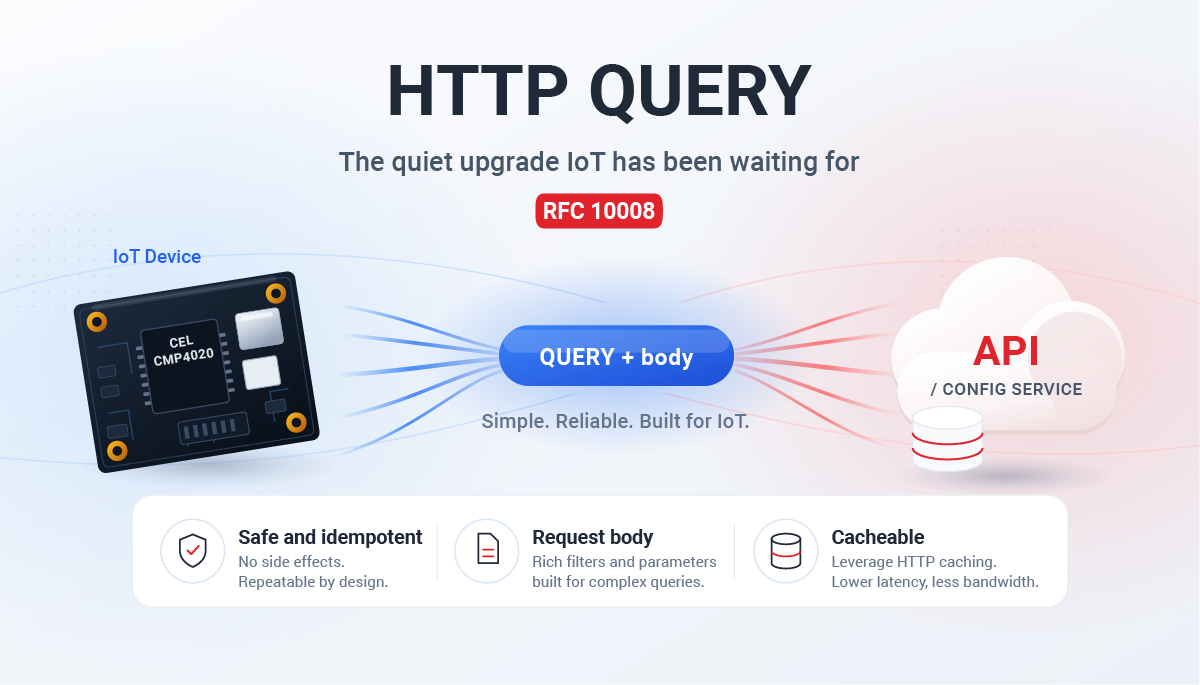


The QUERY Method
After years of discussion, the IETF HTTP working group published RFC 10008, defining the QUERY method for HTTP. The pitch is simple: it uses GET semantics (safe, idempotent, cacheable) with a request body. No more cramming complex filter parameters into a URL, and no more pretending a POST is read-only.
Kreya’s writeup covers the history well. This post is focused specifically on what QUERY changes for embedded and IoT deployments, where the tradeoffs between GET and POST have always been more painful than they are in web development.
What Changed
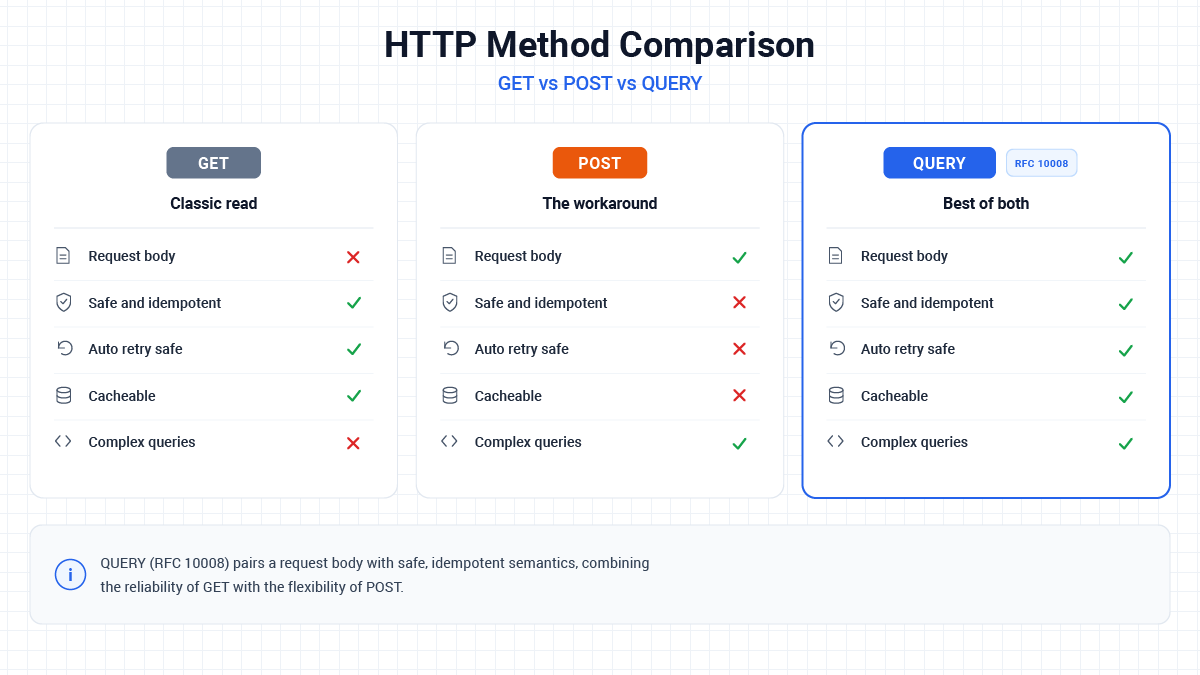
Why This Is Different For IoT
In web development, the choice between GET and POST is mostly a style debate. In embedded systems it is not. Cellular links drop, Wi-Fi cuts out mid-transmission, and your device might be running on a coin cell with strict duty cycles. These constraints make the semantic properties of HTTP methods matter in ways they simply do not in a browser.
The three concrete wins for IoT are auto-retry safety, cleaner complex queries, and fleet-scale caching. Let me walk through each.
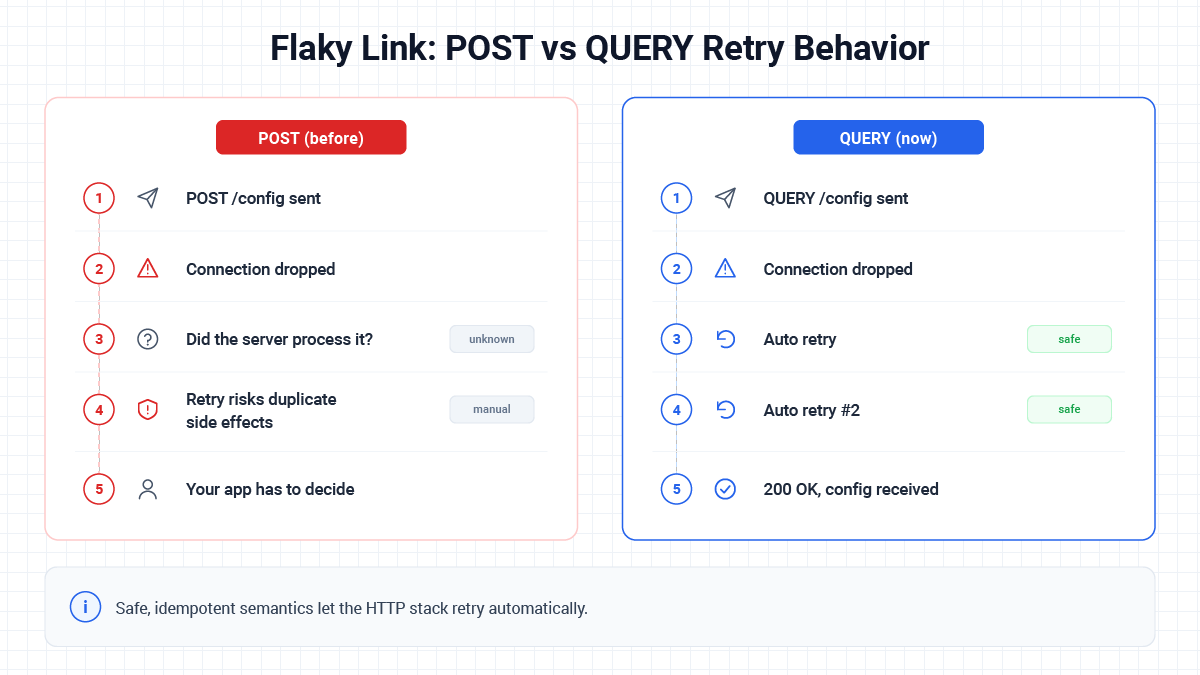
1. Auto Retry on Flaky Links
HTTP client libraries treat safe, idempotent methods as automatically retriable on connection failure. QUERY gets that treatment. POST does not.
Previously, if your CMP4020 needed to send device state as a body to query a config endpoint, you used POST and had to write your own retry logic to avoid triggering side effects twice. With QUERY, the stack already knows it is safe to retry.
2. Complex Device Queries Without URL Hacks
A device often needs to ask the server something specific: “Given my firmware version, hardware revision, region, and current sensor calibration, what config should I be running?” That turns into a 400-character URL. Many proxies, load balancers, and HTTP stacks on constrained hardware have URL length limits somewhere between 512 bytes and 2KB.
The CMP4020 running our embedded HTTP stack hits this in practice when querying config endpoints with rich device context. QUERY puts that where it belongs: in the body.
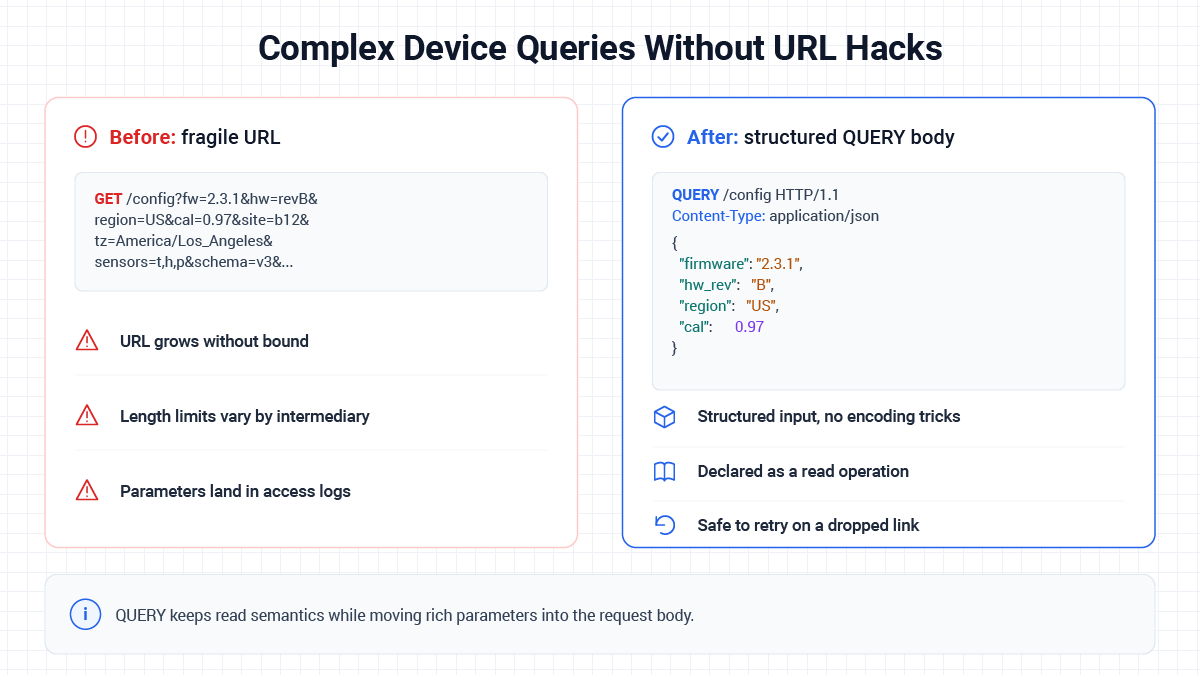 This also matters for OTA update checks, where devices need to send their full manifest to ask what updates apply. That is a natural fit for QUERY: it is a read operation with structured input, and it is safe to retry if the link drops mid-request.
3. Fleet-Scale Caching
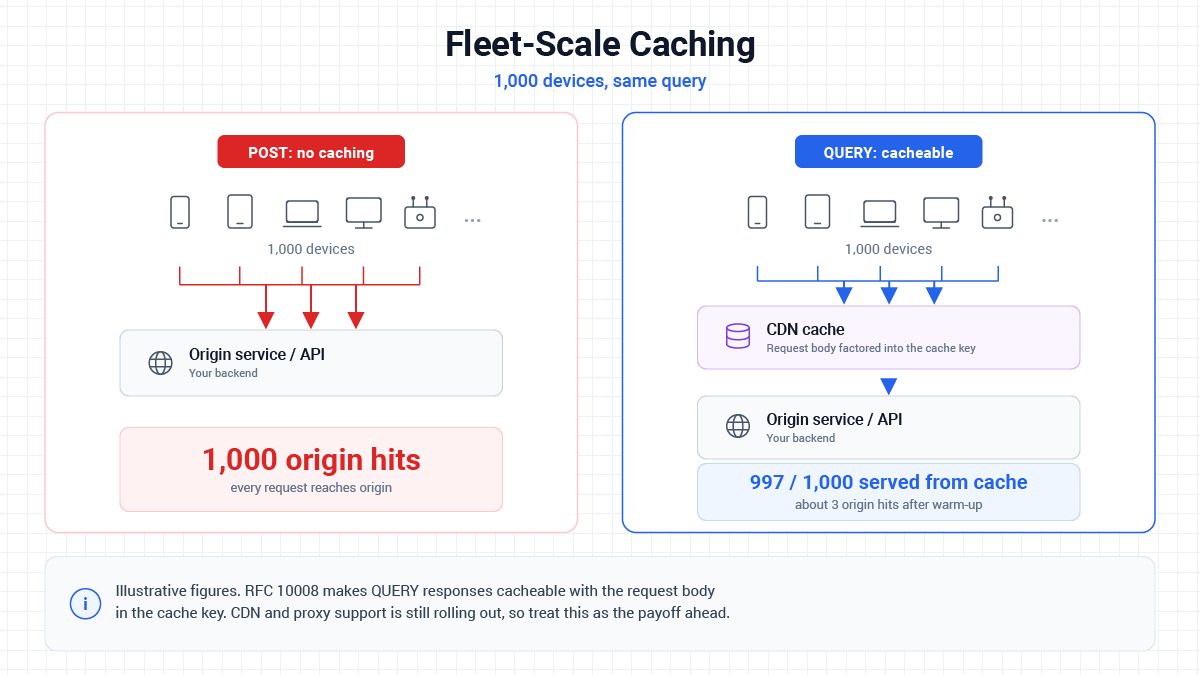
POST responses cannot be cached by CDNs or intermediary proxies. QUERY responses can, with the request body factored into the cache key. If you have thousands of devices asking identical or near-identical questions (firmware update checks, config pulls, rule engine queries), this meaningfully reduces server load at scale.
…Unfortunately
QUERY is brand new. No mainstream web servers (nginx, Apache, Caddy) support it natively yet. Adoption will take years before you can assume middleware in the path handles it correctly.
On the client side this is a non-issue. For most of our devices, the HTTP stack does not care what the method string is. The server side requires a custom handler today, or a framework that lets you register arbitrary methods.
Also worth saying, QUERY does not touch server push or pub/sub. If your use case is the server pushing data to devices asynchronously, QUERY is irrelevant. That is WebSockets, SSE, or MQTT’s domain.
QUERY’s value is specific. Device-initiated reads with complex parameters: config pulls, OTA checks, rule engine queries. If that pattern exists in your system, QUERY simplifies it cleanly. Everything else stays the same.
What to Watch For
Keep an eye on nginx and Caddy changelogs. First-class QUERY support there will be the signal that adoption has tipped. On the embedded SDK side, watch for QUERY to appear as a named constant in your HTTP client library rather than a custom string. That is when it becomes official in your toolchain.
In the meantime you can prototype today with any framework that accepts custom HTTP methods. Most do. The spec is stable, the RFC is published, and the semantics are solid. For new endpoints that are read-only with body requirements, there is no reason not to use it now.
Further Reading
- RFC 10008 – The HTTP QUERY Method (IETF) – The full specification. Covers semantics, caching behavior, and relation to existing methods.
- The new HTTP QUERY method explained (Kreya) – Accessible walkthrough of the motivation behind QUERY, with practical examples and gotchas to watch for during early adoption.